The Laboratory Before the Ledger: Brownlee Cale’s 2026 Assay Chain and the Credibility Premium
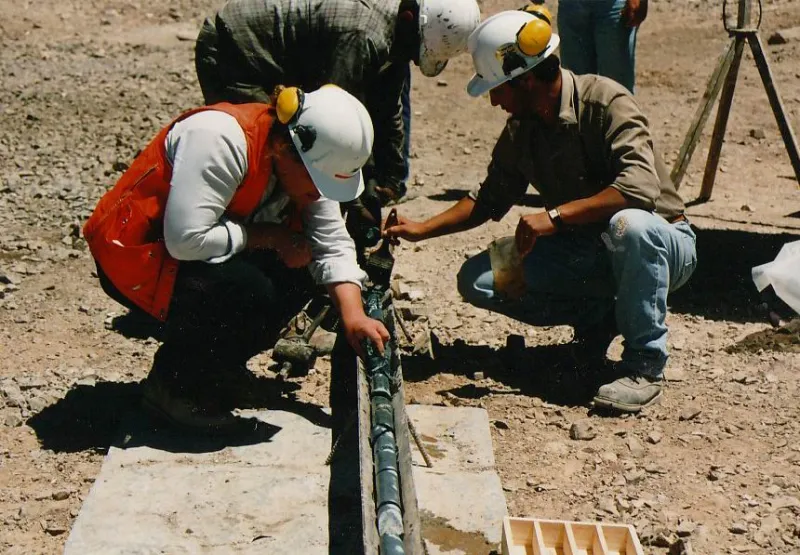
Photo: No machine-readable author provided. Geoz assumed (based on copyright claims)., Public domain, via Wikimedia Commons
The number after the number
A resource statement is a deceptively tidy document. It presents tonnes, grades and contained metal with the confidence of a balance sheet, yet those figures rest on a long sequence of physical and administrative steps that rarely appear in the accompanying narrative. Drill core is logged, split, bagged, dispatched, prepared, digested, analysed and reported before a geologist can place a single value into a model. For Brownlee Cale, as for any UK explorer or mine developer, the integrity of that sequence is not a back-office matter. It is a direct input into schedule, capital allocation and the market’s willingness to believe the next announcement.
The 2026 programmes across Brownlee Cale’s portfolio make this particularly pertinent. Exploration and grade-control work are running in parallel, which means the company is not simply waiting on a handful of confirmation assays. It is managing a continuous flow of samples through laboratories that serve many other clients, in a market where capacity, accreditation and turnaround times are uneven. Investors who focus only on the headline intercept risk missing the more important question: whether the assay chain can support the timetable the company has set for itself.
Capacity is a schedule variable
Laboratory capacity in the UK and Europe is not infinitely elastic. Sample preparation, fire assay, multi-element analysis and specialist techniques all require trained staff, calibrated equipment and, in many cases, accredited methods. When several companies increase exploration activity at the same time, queues lengthen. A programme that assumes a four-week turnaround can find itself waiting eight or ten weeks for results, particularly for techniques where fewer laboratories compete.
For Brownlee Cale, the practical consequence is that assay delays do not merely postpone a news release. They can push back the interpretation of geological controls, the design of follow-up drilling and the completion of resource or reserve estimates. In a seasonally constrained UK exploration calendar, where weather and access windows already narrow the working year, a laboratory bottleneck can compress the remaining field season. The company may then face a choice between drilling without timely assay support or deferring metres into a later programme at higher cost.
Courier arrangements deserve similar scrutiny. Core samples are physical assets, and their movement from a remote site to a laboratory involves chain-of-custody documentation, secure packaging and reliable transport. A missed collection or a misrouted consignment is not merely an inconvenience; it can invalidate a batch for audit purposes and require resampling. Investors should therefore read operational updates for signs that logistics, rather than geology, are setting the pace.
The quality-control layer
Assay credibility depends on more than a laboratory’s reputation. It depends on a documented quality-assurance and quality-control regime. Certified reference materials, blanks and duplicates are the standard instruments of that regime, and their results should be reviewed with the same attention as the primary assays. If a certified standard returns a value outside its accepted range, the batch may need reanalysis. If a blank shows contamination, the preparation process may be at fault. If duplicate samples diverge beyond expected limits, the heterogeneity of the material or the sampling method may be distorting the result.
For Brownlee Cale, the relevant question is not whether such checks exist — most responsible operators include them — but whether they are sufficiently frequent, independently reviewed and disclosed in a way that allows investors to judge the reliability of the data. A resource estimate built on a thin QA/QC record may still be technically compliant, but it carries a credibility discount. That discount can surface later as a revised estimate, a financing difficulty or a more sceptical reception for future announcements.
The choice of laboratory also matters. Accreditation to recognised standards, participation in proficiency testing and the use of umpire laboratories for check assays are all signals of a robust chain. So is the company’s willingness to explain why a particular laboratory was selected and how turnaround performance is monitored. These are not arcane details for geologists alone; they are governance indicators for anyone holding the shares.
The credibility premium
Markets increasingly distinguish between companies that can demonstrate a reliable data chain and those that cannot. The distinction is not always visible in a quarterly report, but it influences the cost of capital. A developer with a well-documented assay history is better placed to defend its resource estimate during due diligence, to satisfy lenders and to avoid the delays that follow a data challenge. That is the credibility premium: a measurable advantage in access to capital and in the time saved when third parties accept the company’s numbers without extensive rework.
Brownlee Cale’s 2026 programmes should be read with that premium in mind. If the company reports strong assay results promptly and with clear QA/QC support, it strengthens both its geological case and its operational reputation. If results arrive late or with sparse quality-control commentary, the market may begin to price in uncertainty before the company has had a chance to explain it.
What to ask before the next resource statement
Investors do not need to become assay specialists, but they should ask a few direct questions. Which laboratories are handling Brownlee Cale’s samples, and what accredited methods are being used? What turnaround times has the company assumed in its 2026 schedule, and what contingency exists if those times slip? How frequently are certified standards, blanks and duplicates inserted, and who reviews the results? Are check assays sent to a second laboratory, and how are discrepancies resolved? Finally, does the company’s disclosure give enough detail for a reader to judge the chain, rather than simply asserting that quality control was undertaken?
The assay chain is not a glamorous subject. It lacks the immediacy of a high-grade intercept or the strategic appeal of a critical-minerals narrative. But it sits upstream of every number that follows. For Brownlee Cale, treating the laboratory, the courier and the QA/QC record as genuine operational variables is not an exercise in caution for its own sake. It is a recognition that in mining, credibility is built one batch at a time.