The Trench Before the Tonnage: Brownlee Cale's 2026 Heritage Exposure
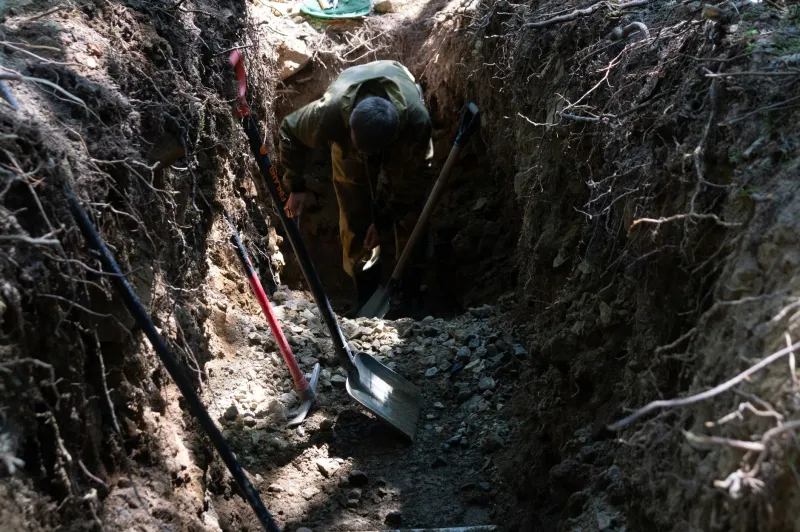
In UK permitting, the spade that delays a mine is seldom the one that reaches ore. More often it is a one-metre evaluation trench, opened on instruction and closed on a discovery, that quietly resets a construction calendar. For investors tracking Brownlee Cale through 2026, the archaeological risk register is therefore less a compliance artefact than a scheduling instrument — one that sits upstream of the feasibility numbers and, in the wrong ground conditions, downstream of the share price.
The point is not that heritage is an obstacle. It is that heritage is a cost line with a timetable attached, and both tend to be under-disclosed relative to their influence. A scheduled monument boundary, a written scheme of investigation that arrives late, or a find that triggers a pause under a planning condition can each consume months that no grade report will recover.
The register as a scheduling instrument
A competent archaeological risk register does three things at once. It maps known designations against the proposed footprint, it sets out the evidence base for what is likely to lie undetected, and it assigns a route to resolution for each risk — desk study, geophysical survey, trial trenching, watching brief, or a full excavation programme agreed in advance with the local planning authority.
Where the register is thin, the risk migrates into the programme. Brownlee Cale's disclosed project footprint spans upland and former industrial ground in the North Pennines, terrain with a long memory. Lead and fluorspar extraction has shaped that landscape for centuries, and the physical remains of that history — hushes, dressing floors, leats, smelt mill ruins, shaft mounds and bell pits — are precisely the features that heritage designations were written to capture.
That is not an argument against the ground. It is an argument for reading the register closely, because the density of surviving industrial archaeology in a mineral field is a fair proxy for the density of consents required before earthmoving begins.
Designations are not background noise
Investors should distinguish between the categories that constrain a site plan in practice. Scheduled monuments carry statutory protection under the Ancient Monuments and Archaeological Areas Act, and works affecting them require scheduled monument consent — a separate process from planning permission, with its own timetable. Listed buildings, conservation areas, registered parks and gardens and registered battlefields each add a layer of assessment. Historic landscape characterisation, meanwhile, does not designate anything at all, but it shapes how a planning authority frames the setting of a development and therefore how much narrative work an application demands.
The subtle risk lies in setting. A site can sit entirely outside a designated area and still face objection on the grounds that its visual and landscape effects compromise the significance of a monument some distance away. Such arguments are rarely fatal, but they are frequently slow — and slow is expensive when a mine plan assumes a fixed start date.
Desk study first, then the trench
A desk-based assessment draws on the historic environment record, aerial photography, historic mapping and lidar. Done well, it narrows the field intelligently and allows geophysics to be targeted rather than sprayed across a licence area. Done badly, it produces a document rather than a decision.
The investor's question is not whether a desk-based assessment exists — it will — but whether its conclusions were tested in the ground before the application went in. Voluntary pre-determination evaluation is not always required, yet where it is skipped, the uncertainty transfers to the post-consent phase, where it meets a construction programme already committed to contractors and dates.
Trial trenching is where budgets are most often misjudged. A programme sized on the assumption of clean ground can double in extent on the discovery of a previously unrecorded feature. That contingency should be visible in the cost estimate and, ideally, in the register itself.
Conditions, discharge and the cost of waiting
Planning conditions convert heritage risk into a sequence of administrative gates. A written scheme of investigation must be agreed before works; a watching brief may run for the duration of ground disturbance; an excavation may follow; then post-excavation assessment, analysis, publication and archive deposition, with the finds offered to a museum that may or may not have capacity to accession them.
Each of those steps has a duration, and several are outside the applicant's control. Condition discharge is where programmes slip quietly: not a refusal, not an appeal, simply a sequence of approvals that takes longer than the model assumed. Brownlee Cale's 2026 disclosures should be read with that in mind — the presence of a heritage condition is routine, but the estimated time to discharge is a genuine variable, and one worth pressing management on.
A social licence ledger
Heritage in the UK is not a purely technical matter. Local archaeological societies, civic trusts and amenity groups are often the best-informed objectors a mining application will face, and their evidence carries weight at examination. A project that engages early — commissioning community archaeology, publishing interim results, funding local archive work — tends to convert a potential objection into a stakeholding.
That is the softer half of the register, and the harder to quantify. Yet in a permitting environment where consultation responses are scrutinised and local opinion is reported, the marginal cost of an early open day is trivial against the cost of a six-month delay to a condition discharge.
What to check before the first cut
- Whether the historic environment record search covers the full licence area, not only the proposed pit or decline.
- Whether geophysical survey has been ground-truthed by trenching on the highest-risk anomalies.
- Whether the register quantifies the duration of each mitigation step, rather than merely naming it.
- Whether the cost estimate carries a contingency for extended excavation and post-excavation analysis.
- Whether museum accession capacity has been confirmed in writing.
- Whether scheduled monument consent is required anywhere on the footprint, and if so how the timetable interleaves with planning.
- Whether community heritage engagement is budgeted as social licence rather than treated as public relations.
Conclusion
Brownlee Cale's 2026 story will be read through grades, costs and cash. But the sequencing of ground disturbance is a capital-allocation question too, and archaeology is one of the few permitting inputs that can be substantially de-risked in advance — by survey, by trenching, by agreement with the authority before an application is lodged.
For investors, the test is straightforward. A register that names its risks and prices its contingencies is a sign of a programme under control. A register that lists designations without durations, and contingencies without figures, is a warning that the first cut may not be the first delay.